China Top 10 Floor Mat Suppliers for Global Buyers
China has become a major sourcing hub for Floor Mats, serving homes, offices, hotels, vehicles, and industrial facilities worldwide. Its supplier base includes factories specializing in rubber mats, PVC runners, microfiber entrance mats, coir products, and custom logo designs. This variety gives global buyers more choices, but it also makes supplier evaluation more difficult.
This guide introduces ten Chinese Floor Mat suppliers for international buyers seeking dependable production partners. The selection focuses on manufacturing experience, product range, customization capability, quality control, export service, and communication standards. A capable supplier should explain material composition clearly, provide practical samples, and show how backing, edge binding, printing, and packaging are handled.
Small details matter.
For example, buyers should inspect whether a mat curls after storage, whether its backing leaves marks on tile, and whether printed colors remain stable after repeated cleaning. Factory audits, test reports, customer references, and transparent production timelines can strengthen purchasing decisions. However, no ranking can replace direct verification. A supplier may perform well for hotel projects but struggle with small retail orders. Another may offer attractive pricing while requiring longer development time.
That difference matters.
The suppliers discussed here should be treated as starting points for careful comparison, not automatic recommendations. Buyers should confirm current certifications, minimum order quantities, sample charges, payment terms, shipping arrangements, and after-sales support before signing an agreement. Honest evaluation is essential, because even a polished catalog cannot reveal every production risk. With clear specifications and consistent communication, global buyers can identify Floor Mat partners that better match their market, budget, and quality expectations.
Types of Floor Mats Supplied by Chinese Manufacturers
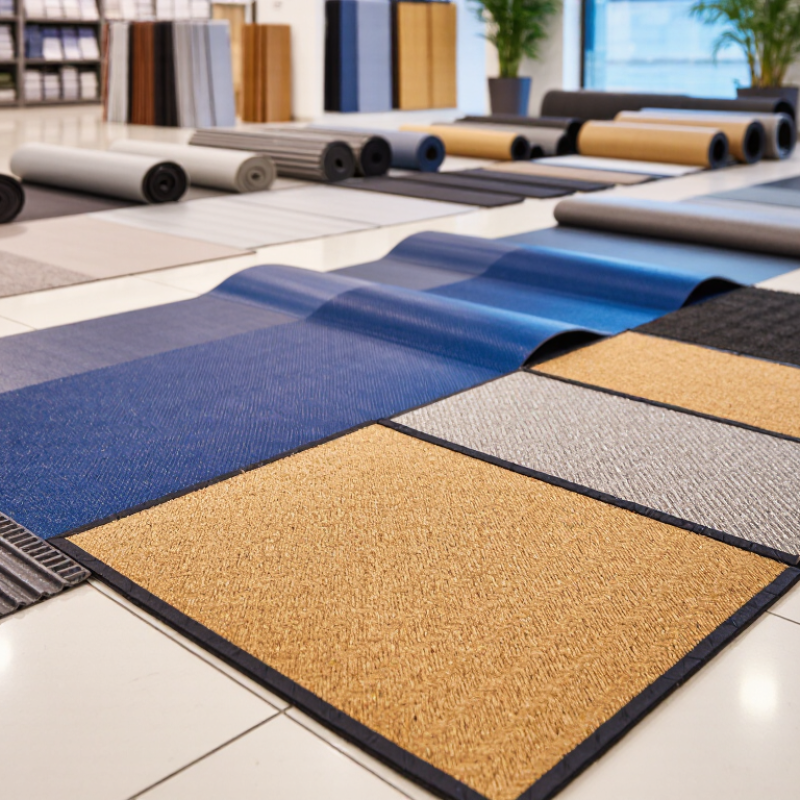
Chinese manufacturers supply floor mats for homes, offices, vehicles, hotels, and industrial entrances. Common types include PVC coil mats, rubber mats, polypropylene carpets, and TPE mats. Each material serves a different purpose.
PVC coil mats trap sand and water through their open-loop structure. They work well near busy entrances and can be cut to specific sizes. Rubber mats provide stronger grip in kitchens, workshops, and commercial corridors. Their raised patterns help reduce slipping, although some surfaces may retain dust. Polypropylene mats offer softer textures and more color choices for homes, reception areas, and retail spaces.
Chinese factories also produce absorbent microfiber mats, diatomite mats, grass mats, and interlocking drainage tiles. Microfiber products dry quickly and suit bathrooms or indoor doorways. Diatomite mats feel firm underfoot, but buyers should check edge finishing and break resistance. Grass mats are practical for balconies and outdoor passages. Interlocking tiles allow damaged sections to be replaced without removing the entire floor.
From supplier evaluations, backing quality deserves close attention. A mat may look attractive but curl after temperature changes. Buyers should request material data, dimensional tolerances, odor testing, and sample washing results. Manufacturing options often include custom colors, logos, thicknesses, and packaging. However, customization can increase minimum order quantities and inspection difficulty. A small sample review often reveals more than a polished catalogue.
China Top 10 Floor Mat Suppliers for Global Buyers
Types of Floor Mats Supplied by Chinese Manufacturers
The chart compares ten commonly supplied floor-mat categories by representative product thickness. Thickness varies by construction, backing, intended use, and customization. The figures are indicative wholesale-market specifications and do not represent any individual company or brand.
Key Criteria for Evaluating Global Floor Mat Suppliers
China Top 10 Floor Mat Suppliers for Global Buyers
Key Criteria for Evaluating Global Floor Mat Suppliers
Selecting a floor mat supplier requires more than comparing unit prices. In my sourcing experience, material consistency often matters more than attractive samples. Check fiber density, backing adhesion, edge stitching, odor, and dimensional stability. Request test samples from different production batches. One sample proves very little.
Independent testing should cover abrasion, colorfastness, slip resistance, and chemical safety. Requirements vary by destination and intended use. ISO 9001 certification can indicate controlled processes, but it does not guarantee every shipment. A supplier should provide recent laboratory reports, test methods, and traceable batch records. Vague documents deserve questions.
Capacity must be verified on the factory floor. Ask about monthly output, peak-season staffing, inspection checkpoints, and subcontracting. The World Bank’s Logistics Performance Index 2023 evaluates customs, infrastructure, shipment arrangements, logistics quality, tracking, and timeliness. These factors directly affect landed cost. UNCTAD’s Review of Maritime Transport reports that over 80% of global merchandise trade by volume moves by sea. Port access and export experience therefore matter.
Do not overlook packaging. Wet cartons, compressed rolls, or weak pallets can damage finished mats before arrival. Commercial terms, replacement procedures, payment protection, and response times should be written clearly. A polished factory tour may still hide weak quality control. I would require a pre-shipment inspection, while admitting that inspections cannot expose every long-term defect. Supplier evaluation is evidence-based, but never perfectly certain.
China’s Top 10 Floor Mat Suppliers and Their Product Strengths
China’s Top 10 Floor Mat Suppliers and Their Product Strengths
China’s top 10 floor mat suppliers serve different buyer needs. One specializes in absorbent microfiber mats for entrances. Another focuses on heavy-duty rubber mats for factories and garages. A third offers soft PVC mats with colorful patterns for homes and children’s spaces. Several suppliers produce coir mats, woven cotton mats, printed logo mats, and anti-slip kitchen runners. Their strengths often include flexible dimensions, private-label packaging, and scalable production. Some factories also provide recycled polyester options and low-odor materials. This variety helps global buyers match products with climate, traffic, and cleaning conditions.
Reliable sourcing requires more than attractive samples. During factory evaluation, buyers should inspect edge binding, backing adhesion, drainage holes, and color consistency. A mat may look excellent in a showroom but curl after repeated washing. That weakness is easy to miss. Ask for abrasion tests, slip-resistance data, material declarations, and pre-shipment inspection records. Suppliers with stable raw-material control usually provide more consistent batches. Still, no supplier is perfect, and production capacity claims deserve independent checking.
Tips: Compare samples from at least three suppliers. Test them on wet tile and rough concrete. Confirm carton strength, labeling accuracy, and replacement procedures before ordering. Keep a written specification sheet. Small details often prevent expensive disputes.
How Global Buyers Can Select and Purchase from Chinese Suppliers
China Top 10 Floor Mat Suppliers for Global Buyers
Global buyers should compare suppliers by production capability, not online rankings alone. Request detailed specifications, including mat size, fiber type, backing material, edge treatment, color tolerance, and packaging method. A reliable supplier should provide clear samples, factory photos, test reports, and realistic production timelines. Ask whether the sample comes from regular production or special preparation. The difference matters.
Before placing an order, verify the supplier’s business registration and export experience. A video factory tour can reveal cutting equipment, storage conditions, and quality inspection steps. For large orders, use a written purchase agreement covering specifications, acceptable defects, delivery terms, payment stages, and inspection rights. Third-party inspection is useful before shipment. It is not excessive.
Calculate the landed cost carefully. Include tooling, sample fees, inland transport, freight, insurance, duties, and warehouse handling. A low factory price may become expensive after shipping. Confirm carton dimensions and loading quantities before approving the quotation. Small details affect the final margin.
Communication deserves practical testing. Send the same questions to several suppliers and compare response accuracy. Vague answers may signal weak process control. Some buyers focus too heavily on price and regret it later. I would still avoid treating certifications as absolute proof; documents should match the actual product and destination requirements. Start with a manageable trial order, record every defect, and improve the specification before scaling.
